Jackson, MS
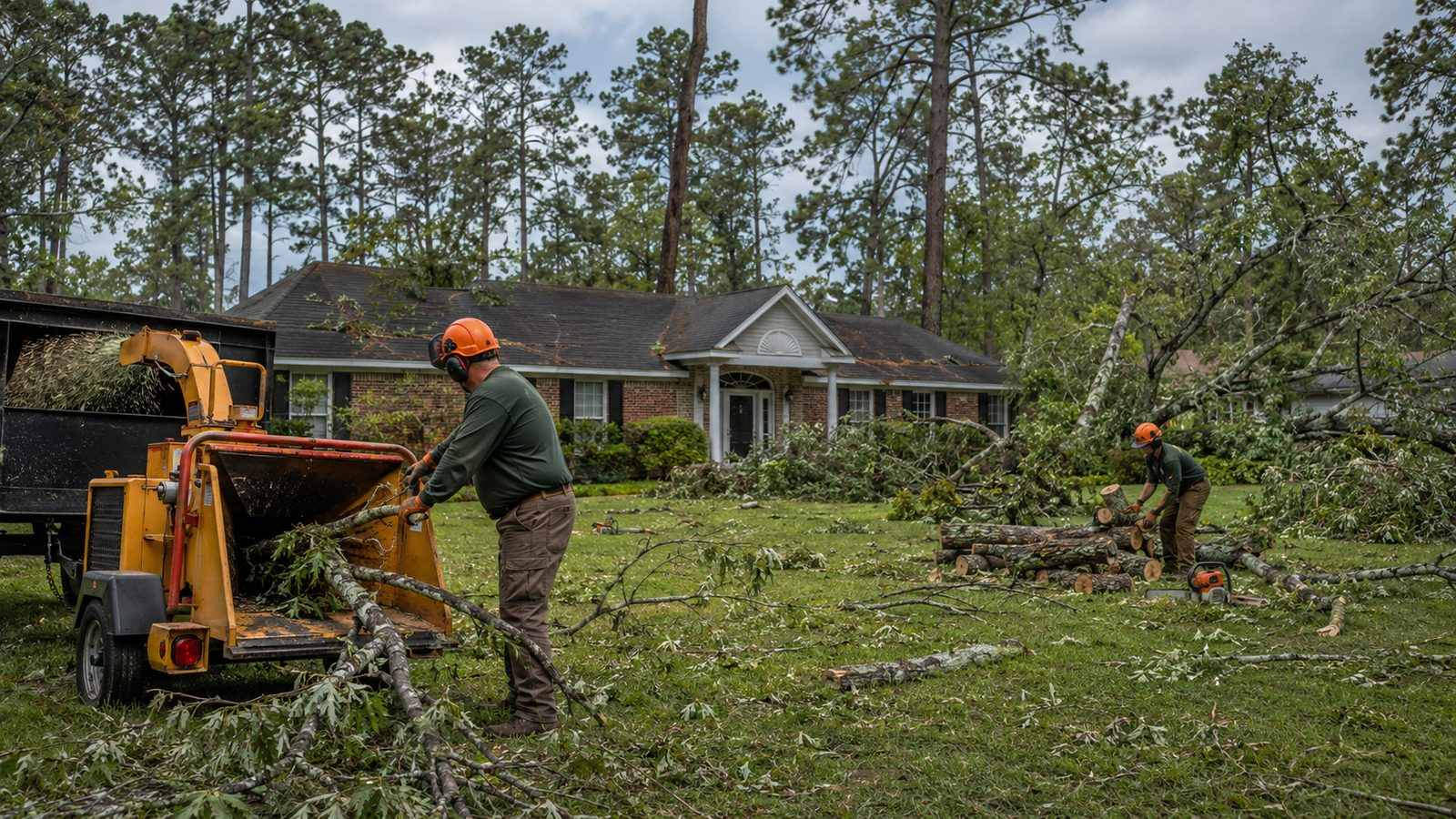
Storm Damage Cleanup in Jackson, MS
Full debris cleanup and hauling after Mississippi storms and high winds.
Licensed & insured · Free estimates · Fast storm responseJackson Tree Pros handles storm damage tree cleanup across the Jackson, Mississippi metro: downed trees, snapped pine tops, hanging limbs, and full debris removal and hauling. We work after severe thunderstorms, straight-line wind events, tropical systems, and ice storms, and we provide itemized documentation for insurance claims. Call (601) 821-1986 for a free estimate.
What does storm damage cleanup include?
Storm cleanup covers everything from making the property safe to hauling the last load off, and it is usually a bigger job than the homeowner first expects. The visible fallen tree is often a fraction of the actual work.
A full cleanup typically includes:
- Removing trees and limbs that have fallen on the ground, on fences, or on outbuildings
- Taking down hangers, the broken limbs still caught up in the canopy that fall later
- Removing snapped or split trunks left standing after the top came out
- Assessing the remaining trees for cracks, root heave, and hidden damage
- Cutting, chipping, and hauling all woody debris off the property
- Raking and clearing the work area, including drives and walkways
- Itemized documentation and photos for an insurance claim
Why do Jackson-area storms hit trees so hard?
Central Mississippi combines three conditions that make tree failure unusually common: pine-dominated canopy, expansive Yazoo clay, and a genuinely severe storm climate. Each one is manageable alone. Together they take trees down.
Loblolly and shortleaf pine dominate lots across Rankin and Madison counties. Pines grow tall and narrow with the mass concentrated at the top, which means they snap in high wind rather than uproot, and a snapped pine top is a heavy object arriving at a steep angle. Water oak, the classic Jackson shade tree, is fast-growing and decays internally by 50 to 60 years old, so a canopy that looks full can be supported by a shell of sound wood.
Yazoo clay is the multiplier. Across much of Jackson and Hinds County this expansive clay swells when saturated and shrinks when dry, working root plates loose over years. A tree that survived twenty seasons can go over in a storm no worse than the last one, because the soil finally let go. Add a storm climate that includes severe thunderstorm lines in spring and fall, tropical remnants moving up from the Gulf, and an ice event every several winters, and the failure rate makes sense.
What should you do immediately after a storm?
Assess from a distance first, treat every wire as live, and photograph everything before anything is moved. That order protects both your safety and your claim.
The immediate checklist: stay away from any downed or sagging wires and anything touching them, and call Entergy Mississippi rather than approaching. Walk the property from a safe distance and look up, since hangers in the canopy are the single most dangerous thing on a post-storm property and they are easy to miss. Check trees for fresh lean, cracked soil at the base, and split trunks. Photograph everything, wide and close, before cleanup begins. Then call your insurance carrier and a tree service.
Do not run a chainsaw on storm debris unless you genuinely know how to read tension and compression in bound wood. Storm-felled trees store enormous energy, and a bar pinched in a loaded trunk or a limb that springs when released causes serious injuries every single storm season in Mississippi.
Will insurance cover storm tree cleanup?
Mississippi homeowners policies generally cover tree removal when a tree damaged a covered structure, and generally exclude removal of trees that fell without hitting anything. Most policies carry a per-tree or per-occurrence cap, commonly in the $500 to $1,000 range, plus your deductible.
Where it gets better: many policies also cover removal when a fallen tree is blocking a driveway or a handicap-access ramp, even with no structural damage. That provision is frequently overlooked. Where it gets worse: debris from a tree that simply fell in the yard is usually the homeowner's cost, and so is preventive removal of a tree that is now visibly hazardous but has not yet failed.
How to protect the claim: photograph before touching anything, keep all invoices, get the work itemized rather than lumped into one number, and open the claim before cleanup where it is safe to wait. We provide itemized invoices and photo documentation, and we are used to working alongside adjusters. This is general information rather than insurance advice, so confirm the specifics with your own policy or agent.
What about the trees left standing after the storm?
The trees still standing after a storm deserve as much attention as the one that fell, because storm damage is frequently invisible from the ground. A tree that looks untouched can have a fresh crack in a main union forty feet up, or a root plate that shifted just enough to fail in the next event.
What we look for on a post-storm assessment: hangers caught in the canopy, fresh cracks in trunks and branch unions, torn bark where a limb ripped out, a lean that was not there before, soil cracking or mounding on the side opposite a lean, and exposed or lifted roots. On pines specifically, a snapped or missing top is terminal, and that tree should come out rather than be left to fail again.
Getting the standing trees assessed while the crew is already on site costs nothing extra and is the cheapest insurance available after a storm.
What areas do you serve for storm damage cleanup?
We provide storm damage cleanup in Jackson and across the metro in Hinds, Rankin, and Madison counties, including Clinton, Brandon, Madison, Ridgeland, Pearl, Flowood, Byram, Gluckstadt, Canton, Raymond, Florence, Richland, Terry. See all service areas.
What other tree services do you offer?
We are a full-service crew, and most customers combine two or three services on one visit because it costs less than separate trips.
- Tree Removal: Safe removal of dead, dying, hazardous, or unwanted trees of any size.
- Tree Trimming & Pruning: Crown thinning, deadwood removal, and clearance pruning to keep trees healthy.
- Stump Grinding & Removal: Grind stumps below grade so you can reclaim your yard and replant.
- Emergency Tree Service: Storm-downed and leaning trees cleared fast across the metro.
- Land & Lot Clearing: Brush, undergrowth, and tree clearing for lots, fence lines, and new builds.
Related guides
FAQ
Storm Cleanup Questions
How much does storm damage cleanup cost in Jackson, MS?
Storm cleanup pricing depends on volume, access, and whether anything is under tension or on a structure. A yard full of limbs and brush is priced by the load and the crew hours. A tree that fell on a house falls under emergency work, which in this area typically runs $800 to $2,000 or more. Call (601) 821-1986 for a free written estimate, and we itemize the invoice for insurance.
Do you provide documentation for an insurance claim?
Yes. We provide itemized invoices and photo documentation suitable for a homeowners claim, and we are used to working alongside adjusters. The most useful thing you can do is photograph the damage from several angles before anything is moved, and open the claim before cleanup where it is safe to wait. Get the work itemized rather than lumped into a single number.
How fast can you respond after a storm in the Jackson metro?
We dispatch as fast as crews and conditions allow and prioritize danger first. Be realistic about regional events: when a severe line crosses central Mississippi, every tree company in the metro takes hundreds of calls in the same few hours. We triage trees on occupied structures and blocked emergency access ahead of yard debris. Call (601) 821-1986 and describe exactly what you are looking at.
Do you haul away all the storm debris?
Yes, full debris removal and hauling is included in our storm cleanup. Brush is chipped, trunk wood is cut and loaded, and the work area is raked. If you want the trunk wood cut to firewood length and stacked, or the chips left as mulch, say so during the estimate and we will do it at no extra charge.
A limb is hanging in my tree after the storm, is that urgent?
Yes. A hanger, meaning a broken limb still caught in the canopy, is the most dangerous thing on a post-storm property. It is loose, it is heavy, and it will come down without warning, usually on a still day when someone has gone back to normal and is standing underneath it. Keep everyone out from under it and get it removed. Do not try to pull it down with a rope from the ground.
Should I remove a pine that lost its top in a storm?
Yes. A pine that snapped its top will not recover. Unlike many hardwoods, pines do not regenerate a new leader from a broken trunk, so the tree is left with reduced canopy, an open wound that invites bark beetles and decay, and no way back to a stable form. It becomes a standing hazard that fails again in the next storm. Removal is the honest recommendation.
Can you check my other trees while you are here?
Yes, and we recommend it at no extra charge while the crew is on site. Storm damage is often invisible from the ground: fresh cracks in high unions, torn bark where a limb ripped out, a new lean, or soil heaved on the side opposite a lean. Catching a compromised tree now is far cheaper than removing it off your roof after the next storm.
Need a Tree Handled?
Call now for a free estimate. Fast scheduling, fair pricing, and full cleanup, every time.
Call (601) 821-1986